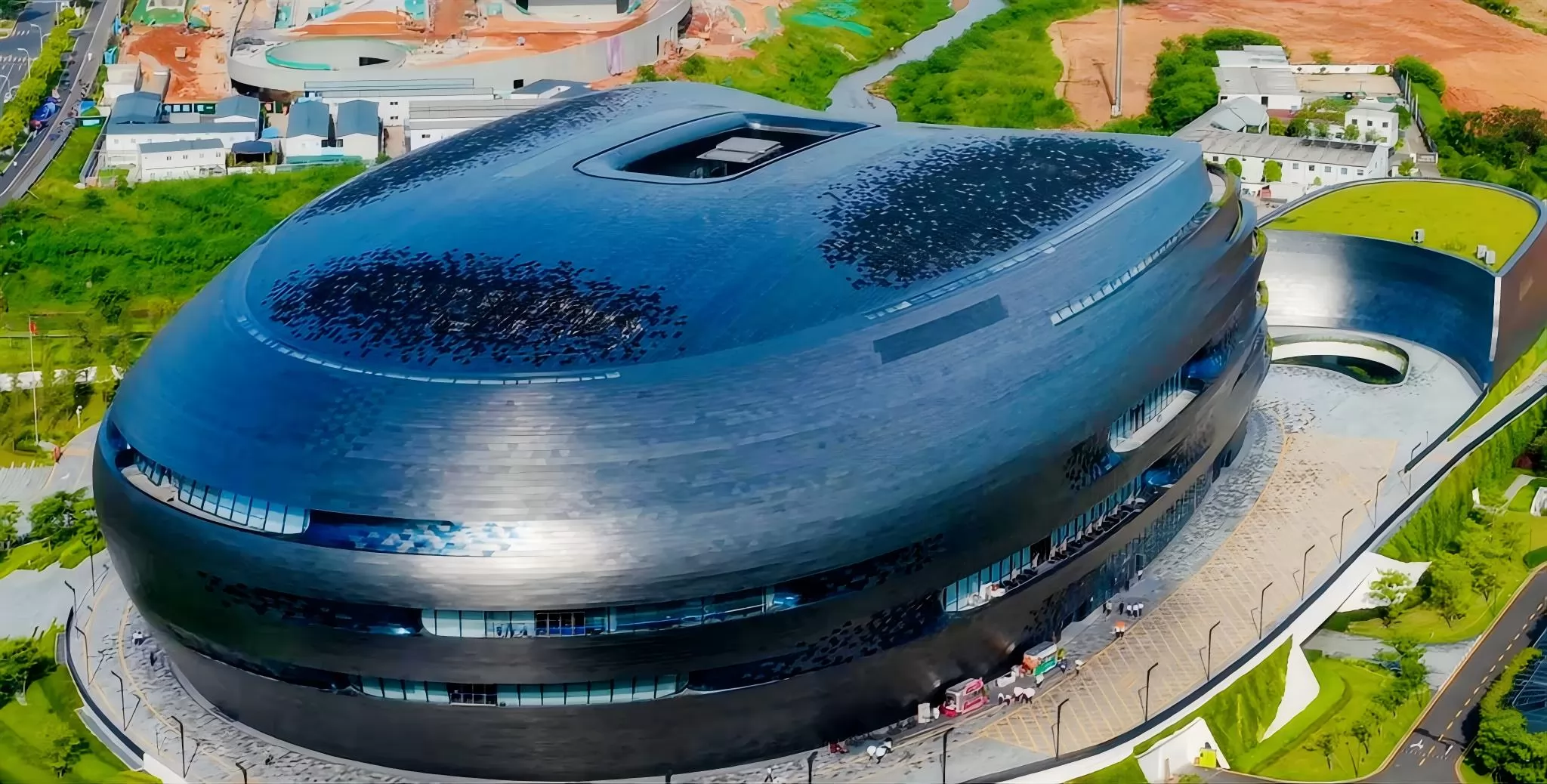
Project Location: Shenzhen
Product Name: Colored Glaze· Dark Black
Installed Capacity: 61kW
Installed Area: 376㎡
Design Advantages: Shenzhen's first BIPV+ Digital Civilization Innovation Science and Technology Museum, setting a benchmark for innovation.
The Shenzhen Science and Technology Museum (new building), themed "Digital Civilization Unlocks Innovation and the Future," incorporates a BIPV smart power generation system,
achieving a scientific match between renewable energy and the smart grid through overall planning and design.
At locations where the curvature of the main building's skylight roof is relatively gentle, 608 panels of Colored Glaze·Dark Black (product size: 100W 1492*550mm) photovoltaic green building materials are installed.
The black surface color matches the color of the roof aluminum panels and metal curtain wall, creating a visually striking futuristic architectural form that adds a touch of mystery to the science museum.
Furthermore, the products possess excellent thermal stability, aging resistance, insulation performance, and adhesion, with a lifespan comparable to the building itself.
As one of Shenzhen's "Top Ten Cultural Facilities of the New Era," the Shenzhen Science and Technology Museum will become a shining pearl in the Guangdong-Hong Kong-Macao Greater Bay Area and the Guangzhou-Shenzhen Science and Technology Innovation Corridor,
and an important base for young people to learn scientific knowledge, stimulate their spirit of exploration, and cultivate their innovative abilities.
Energy-saving effect: The building is equipped with 61kW of photovoltaic green building materials. Based on the daily radiation and power generation efficiency, it can generate 186 kWh of electricity per day,
enough to power a 7kW projection device, a 5kW smart screen system, a 9kW astronomical dome theater system, and a 2kW lighting system for 8 hours (day).
It provides 67,900 kWh of green electricity to the building annually, reducing greenhouse gas emissions from the combustion of 27.16 tons of coal, equivalent to a reduction of 22.49 tons of carbon dioxide and 0.81 tons of sulfur dioxide.