Oct. 12, 2026
Natural daylight is an important part of modern commercial building design. Shopping malls, railway stations, office buildings, and exhibition centers often use large glass skylights to create bright, open interior spaces. However, conventional skylights serve mainly as a source of daylight, leaving much of the roof's potential for solar energy generation unused.
What if these glass surfaces could generate electricity while still allowing sunlight into the building?
This is the idea behind solar skylights. By incorporating photovoltaic cells into architectural glazing, building-integrated photovoltaic (BIPV) technology makes it possible to combine natural lighting, renewable electricity generation, and building-envelope functions within the same structure.
The challenge is finding the right balance. Solar skylights do not transmit as much light as conventional clear glass in every configuration, but careful material selection and architectural design can preserve useful daylight while generating electricity.
A solar skylight, also called a photovoltaic skylight or BIPV skylight, is a roof glazing system that incorporates photovoltaic technology.
Unlike conventional solar panels mounted above a roof, solar skylights are integrated into the building envelope. They can replace portions of traditional skylight glazing while performing two functions: admitting daylight and converting sunlight into electricity.
The operating principle is straightforward.
When sunlight reaches the photovoltaic cells embedded in the glass module, the cells convert part of the incoming solar energy into direct current (DC) electricity. This electricity is collected through electrical connections and typically converted into alternating current (AC) through an inverter for building use.
Meanwhile, light passes through transparent areas or light-transmitting photovoltaic materials, illuminating the interior below.
The result is a multifunctional building component that combines photovoltaic power generation with architectural glazing.
For commercial developers, this approach creates an opportunity to use roof areas that would otherwise be reserved exclusively for natural lighting.
The key technology is semi-transparent photovoltaic glass.
Instead of covering an entire glass surface with opaque solar cells, manufacturers can use different photovoltaic materials and layouts to control how much daylight passes through.
One common approach involves arranging crystalline silicon solar cells within transparent laminated glass.
The cells absorb sunlight to generate electricity, while spaces between them allow daylight to enter the building.
By adjusting cell spacing and coverage, manufacturers can create different levels of transparency.
A higher cell coverage ratio generally provides more active photovoltaic area, while wider transparent gaps allow more natural light to pass through.
However, increased transparency usually reduces the power-generating area within a module of the same dimensions.
This makes cell arrangement an important design decision for architects and building engineers.
Another approach uses photovoltaic materials designed to transmit a portion of visible light.
Certain thin-film technologies can create a more uniform appearance than spaced crystalline silicon cells, although their efficiency, color, durability, and transparency vary.
Emerging photovoltaic technologies are also being investigated for their ability to selectively absorb certain wavelengths while allowing more visible light through.
These technologies offer different possibilities for architectural applications, but their commercial maturity and long-term performance must be evaluated individually.
Transparency is not the only consideration in skylight design.
For commercial buildings, glass color, surface appearance, module dimensions, and cell patterns may also affect the visual experience.
Customized BIPV glass can help architects integrate electricity generation into roof structures without treating photovoltaic modules as separate additions.
For example, colored or patterned photovoltaic glass may be suitable for exhibition halls, cultural buildings, and transportation facilities where architectural appearance is an important project requirement.
The final design should consider both the exterior appearance and the quality of daylight transmitted into the building.
One of the most important specifications for a solar skylight is visible light transmittance (VLT or VT).
This indicates how much visible light passes through the glazing. Average visible transmittance (AVT) is also commonly used in research on semi-transparent solar cells.
A higher transmittance value generally allows more daylight into the building, but it does not automatically mean better overall performance.
The relationship between transparency and photovoltaic output involves trade-offs.
Design Factor | Higher Transparency | Lower Transparency |
Natural daylight | More light can enter | Less light enters |
PV cell coverage | Often lower with spaced-cell modules | Often higher |
Electricity generation | May decrease for the same module area | May increase |
Glare control | More attention may be needed | Can reduce direct sunlight |
Artificial lighting | May reduce lighting demand | May increase lighting demand |
Thermal comfort | Depends on glazing properties and climate | Depends on glazing properties and climate |
The objective is not necessarily to maximize either transparency or solar output. It is to identify the combination that best supports the building's total energy performance and indoor environment.
A study published in Scientific Reports in June 2026 examined the relationship between visible light transmittance, solar cell efficiency, and building lighting energy consumption.
The researchers found that the most suitable balance between transparency and electricity generation varied by location.
In the modeled conditions, higher-transmittance photovoltaic materials offered advantages in Guangzhou, while configurations with higher photovoltaic efficiency and lower transmittance could perform better in other locations.
The findings suggest that selecting BIPV glass solely on its rated electrical efficiency may overlook its effect on indoor lighting requirements.
Although the study focused on semi-transparent photovoltaic glazing rather than every type of skylight, the same design principle is relevant: a solar skylight should be evaluated as part of the building, not just as a power-generating module.
For architects and project developers, location-specific simulations are essential before selecting a final transparency level.
Solar skylights influence more than indoor brightness.
Large areas of overhead glazing can introduce significant solar heat gain, particularly in warm climates and buildings with extensive glass roofs.
Without suitable solar control, excessive sunlight may increase cooling requirements and create uncomfortable conditions for occupants.
Solar skylights can help manage this issue by incorporating photovoltaic cell coverage, glazing layers, and appropriate solar-control features.
However, the actual result depends on the complete glazing assembly rather than the photovoltaic cells alone.
Three parameters are particularly important:
Visible Light Transmittance (VLT): Determines how much visible light enters the building.
Solar Heat Gain Coefficient (SHGC): Indicates the proportion of incident solar energy entering the building as heat.
U-value: Describes the rate of heat transfer through the glazing system.
A well-designed photovoltaic skylight must balance these properties with electricity generation.
For example, a shopping mall in a warm climate may benefit from a skylight that limits excessive solar heat gain while maintaining enough daylight for public areas.
A building in a colder climate may have different requirements, including winter daylight availability and heating demand.
Recent research published in Energy Strategy Reviews in 2026 also emphasizes that photovoltaic glazing performance should be evaluated through electricity generation, thermal insulation, solar heat gain, and daylight availability together.
Consequently, the most effective solar skylight design depends on the building's climate, roof geometry, glazing construction, and daily operating patterns.
Selecting photovoltaic glass is only one part of developing a successful solar skylight system.
For architects, contractors, and commercial building owners, the following factors should be addressed during the early design stage.
Solar radiation varies significantly between locations.
Roof orientation, inclination, surrounding buildings, and shading from structural elements all influence electricity generation.
Project-specific solar simulations help determine suitable module placement and expected annual output.
Different building spaces require different lighting conditions.
A transportation terminal may need broad daylight distribution across large public areas, while an office atrium may require closer attention to glare and occupant comfort.
Designers should evaluate daylight distribution throughout the year rather than relying on a single transmittance figure.
Photovoltaic glass can be customized with different cell arrangements, dimensions, colors, and transparency levels.
For projects requiring both daylight and power generation, designers may use different glazing configurations across the roof.
Areas with greater daylight requirements can incorporate higher-transmittance modules, while other sections may prioritize electricity generation.
Unlike conventional ground-mounted solar modules, photovoltaic skylights also function as overhead building-envelope elements.
Glass strength, support structures, wind resistance, drainage, weather sealing, and electrical safety must be considered together.
The glazing configuration must comply with applicable local building codes and overhead glazing requirements.
Special attention is needed for complex roof geometries, curved structures, and large-span commercial buildings.
Commercial skylights are often installed in locations that are difficult to access after construction.
Project teams should consider inspection access, module replacement, cleaning, drainage maintenance, and the serviceability of electrical connections.
A coordinated architectural and electrical design can help reduce future maintenance difficulties.
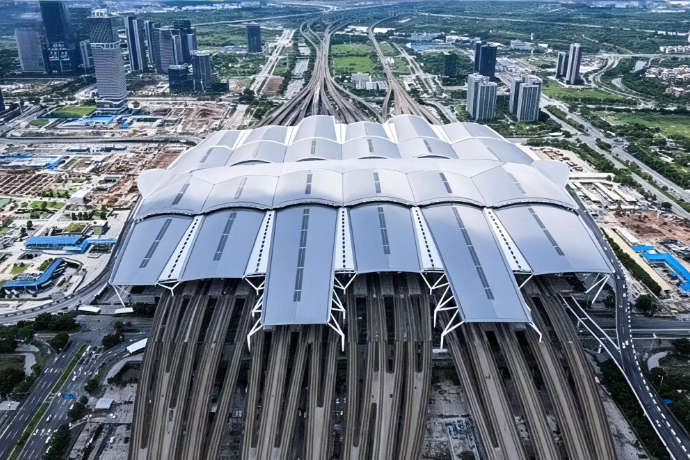
A practical example of photovoltaic skylight integration can be found at Guangzhou South Railway Station in China.
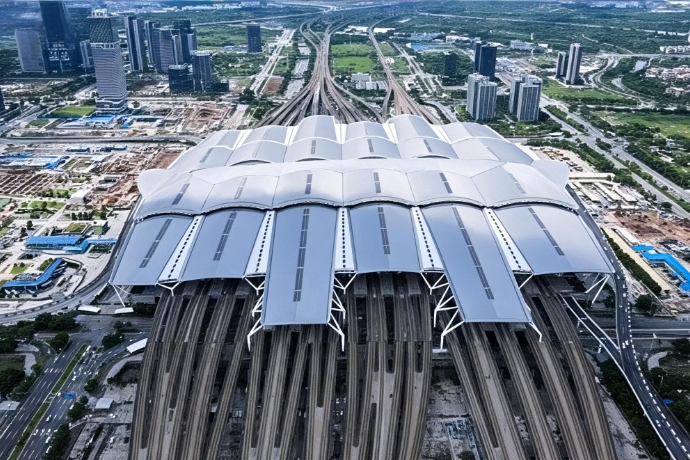
Guangzhou South Railway Station
Completed in 2009, the project was among the country's earlier public-building applications of BIPV technology.
Gain Solar supplied photovoltaic building materials integrated into the station's large-span architectural structure.
According to the published project information, the installation includes:
Project Parameter | Specification |
Project location | Guangzhou, China |
Installation year | 2009 |
BIPV installation area | 2,000 m² |
Installed photovoltaic capacity | 121 kW |
Reported annual electricity generation | 145,000 kWh |
Main application | Architectural roof and skylight integration |
The project uses Gain Solar's Colored Glaze · Crystal Clear photovoltaic building materials.
Its design combines double-glazed photovoltaic products with the station's large-span arched structure. Higher-transmittance products are used around the central skylight area to accommodate natural lighting requirements.
This approach illustrates an important principle of BIPV design: different areas of the same roof can serve different architectural and energy functions.
Instead of choosing between daylight and electricity generation, the project integrates both into the overall roof design.
Solar skylights are particularly relevant for commercial and public buildings that require large daylight openings.
Shopping Malls and Retail Centers
Large atriums often rely on natural overhead lighting. Photovoltaic skylights can introduce renewable energy generation while maintaining the bright interior environments expected in retail spaces.
Railway Stations and Transportation Hubs
Transportation facilities frequently use large-span roofs and skylights. Integrating photovoltaic materials into these structures can support on-site electricity production without eliminating natural daylight.
Exhibition Halls and Convention Centers
Exhibition venues often have substantial roof areas and distinctive architectural designs. Customized solar glazing can combine daylight, power generation, and visual identity.
Office Buildings and Commercial Atriums
Solar skylights can provide daylight to shared interior spaces while contributing to building energy strategies. Appropriate glare control and thermal performance remain essential.
In each application, the available roof area, structural conditions, and interior lighting requirements determine whether BIPV glazing is technically and economically suitable.
For commercial projects, comparing solar skylight products based only on rated wattage or glass transparency can lead to an incomplete assessment.
A more useful evaluation considers the entire roof system.
Project teams should request technical information covering glass dimensions, photovoltaic capacity, transmittance, thermal properties, structural configuration, safety requirements, and installation conditions.
They should also compare different design options through daylight and energy modeling before finalizing the glazing specification.
For new construction, early coordination between architects, facade engineers, electrical designers, and BIPV suppliers can help avoid conflicts between architectural and photovoltaic requirements.
Gain Solar provides customized BIPV glass and building-integrated photovoltaic solutions for skylights, roofs, facades, and other architectural applications. Available design options include different glass dimensions, module appearances, and transparency configurations to suit project requirements.
Solar skylights demonstrate how photovoltaic technology can become part of a building's architectural design rather than simply being installed above it.
By using semi-transparent photovoltaic glass, controlled solar cell spacing, and suitable glazing configurations, these systems can generate electricity while preserving useful natural daylight.
The most important consideration is balance.
Higher solar output is not always the best outcome if it significantly increases artificial lighting demand or compromises indoor comfort. Likewise, maximizing transparency may reduce the electricity-generating potential of the available roof area.
For commercial developers and architects, a successful BIPV skylight should meet the building's lighting, thermal, structural, and energy requirements together.
To discuss a customized solar skylight project, contact Gain Solar with your roof drawings, installation location, glazing specifications, and daylighting requirements.